
AI Legal Briefs · Child Welfare · Hard-RAG Grounded
Advocate generates a partisan legal brief for your child-welfare case — grounded in Lovdata statutes, ECHR judgments, and Bufdir guidance. Every argument is framed to strengthen your position. Every citation is verified against 220,000+ indexed legal passages before it reaches you.
What you get
Every sub-question, retrieval pass, and the final brief is framed to strengthen your client's position — and expose weaknesses in the opposing side. Select your party role once; the agent stays partisan throughout.
Sources drawn from Lovdata, ECHR HUDOC, Bufdir guidance, and Norwegian court decisions. Every claim in the brief is traced to a retrieved passage. If it can't be verified — it doesn't appear.
Drop in PDFs, court orders, expert reports (DOCX or TXT). Your documents are chunked and searched alongside the legal corpus — blended into the same retrieval pass. Processed in memory only, never stored or logged.
How it works
Three steps from blank form to a legally grounded partisan brief. No legal training required.
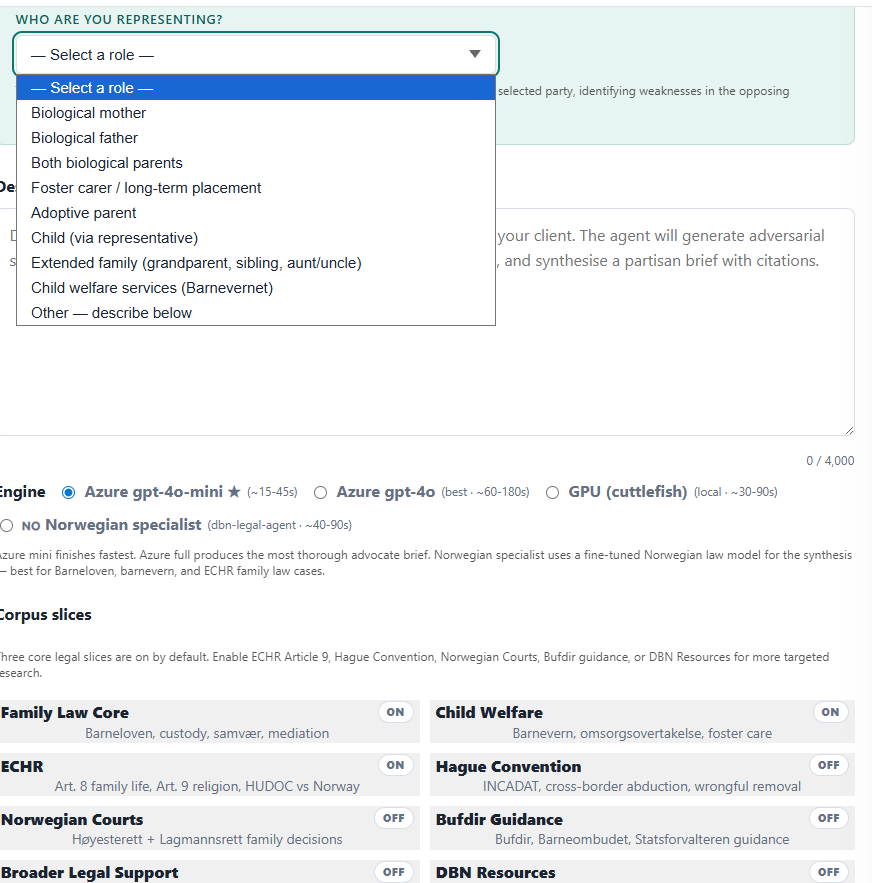
Select from 9 party roles — biological parents, foster carer, adoptive parent, child, extended family, or Barnevernet. The agent frames every sub-question and citation to argue for the selected party.
E.g. "Biological father" — the brief argues for preserving or restoring parental contact under barneloven and ECHR Art. 8.
Paste or type the facts of the case (up to 4,000 chars). Optionally upload case documents — court orders, expert reports, correspondence. The agent reads both the legal corpus and your files.
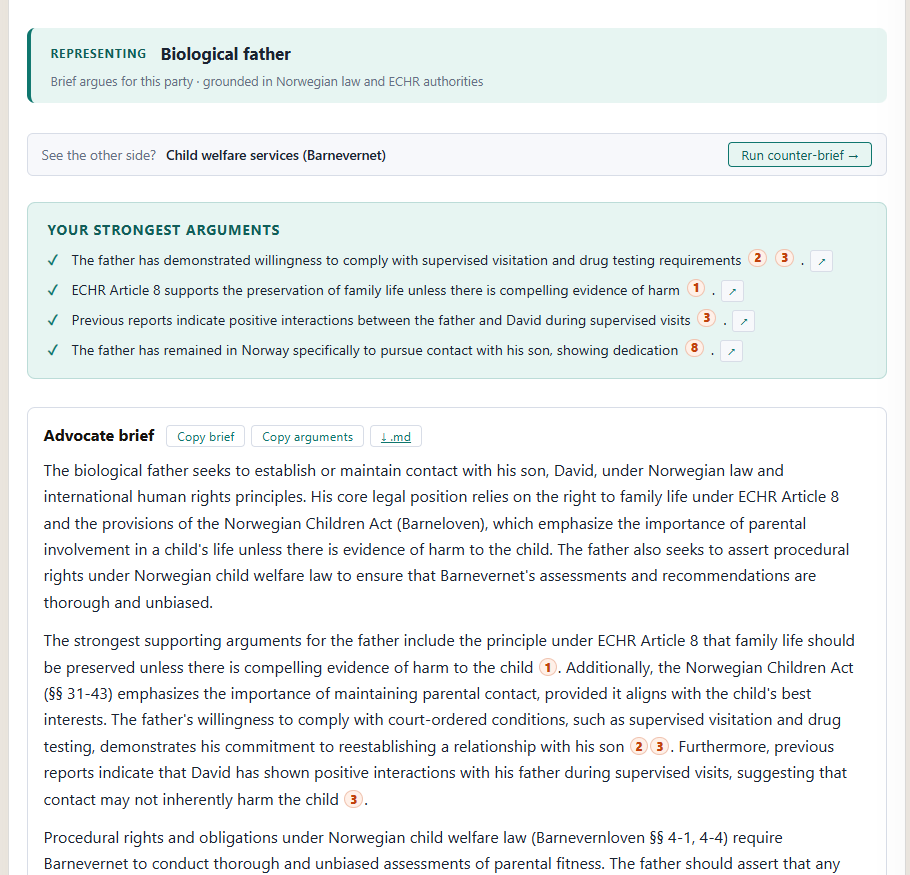
Output: YOUR STRONGEST ARGUMENTS · Advocate brief · GAPS IN THE OPPOSING POSITION · Sub-question research trail.
The agent generates adversarial sub-questions, retrieves applicable law, and synthesises a partisan brief with inline citations. One click to run a counter-brief for the opposing party — useful for anticipating the other side's arguments.
Runs in 15–180 s depending on engine. Counter-brief available in one click.
Screenshots
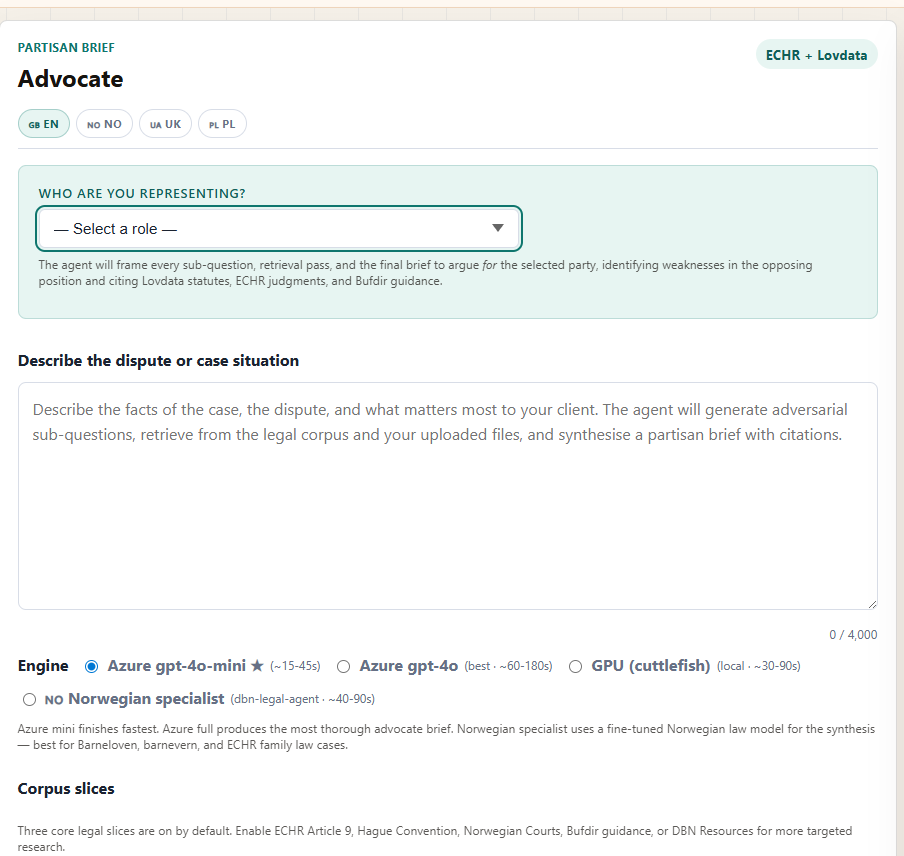
The form: select who you're representing, describe the case, choose engine and corpus.
Output: your strongest arguments with citation sources, then the full advocate brief.
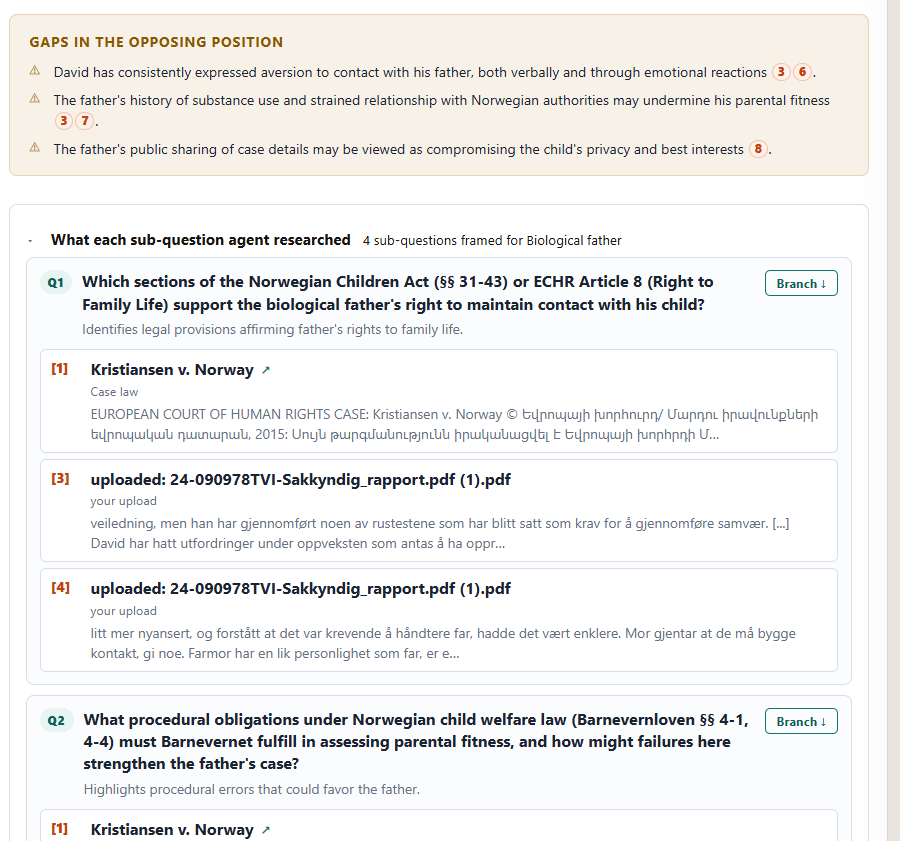
Research trail: each sub-question with retrieved sources — ECHR cases and uploaded documents.
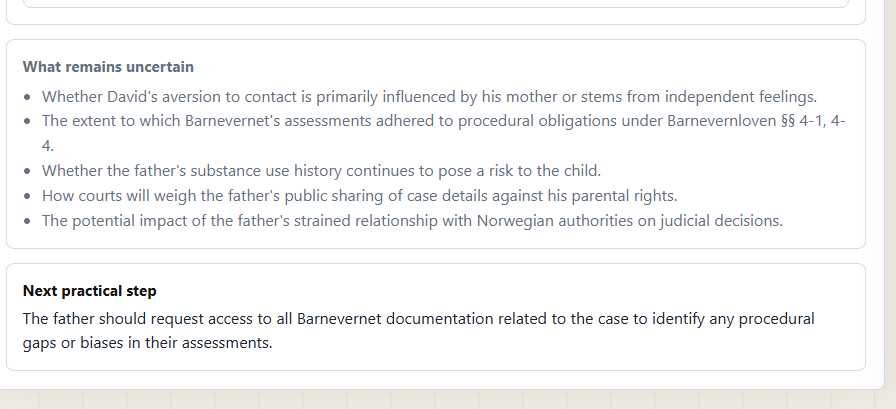
Analysis: gaps in the opposing position, what remains uncertain, and your next practical step.
Under the hood
A QLoRA fine-tune trained on Norwegian child-welfare and administrative law text. Unlike a general-purpose LLM, dbn-legal-agent understands the procedural vocabulary of barnevernsloven and barneloven — what ECHR Art. 8 requires in care-order cases, how Barnevernet's duty of assessment under §§ 4-1, 4-4 can be challenged, what the proportionality threshold is for omsorgsovertakelse. It runs alongside Azure gpt-4o to shape the argument structure of every brief.
Party roles
Selecting a party role tells the agent whose position to defend. Sub-questions, retrieval, and the final brief all follow the chosen side.
Biological mother
barneloven · ECHR Art. 8
Biological father
barneloven · ECHR Art. 8
Both biological parents
barneloven · barnevernsloven
Foster carer / long-term placement
barnevernsloven § 4-19a
Adoptive parent
adopsjonsloven · barnevernsloven
Child (via representative)
barneloven · FNs barnekonvensjon
Extended family
barneloven · ECHR Art. 8
Child welfare services (Barnevernet)
barnevernsloven · fvl
Other
fvl (general)
Free for Do Better Norge members. No credit card required.